 Add to Chrome
 Add to Firefox
 Add to Edge
Move the Query, Not the Cache: Characterizing Cross-Instance Latent Attention Redistribution Across GPU Fabrics
May 31, 2026
Frontier LLMs increasingly decide what a query attends to with a sparse-attention indexer that picks a few KV-cache blocks per query: attention's unit is now a small, reusable chunk. Agentic workloads hammer it: many sub-agents query one large codebase, reusing the same blocks. When that corpus outgrows one GPU it is partitioned across instances, so a query and the blocks it selects often sit on different GPUs: answering it means attention across instances. The reflex of prior cross-instance KV systems is to move the cache: pull the selected blocks to the requester. Multi-head Latent Attention inverts the arithmetic, compressing each token's key and value into one narrow vector, so a routed query row is only ~1 KB, smaller than the chunk it attends; routing the query is then often cheaper than moving the cache. Which primitive wins, over which fabric and request shape, is uncharted, least of all on device-initiated RDMA that makes per-request cross-node transfers cheap. We characterize cross-instance MLA attention on a real multi-node H100 cluster, distilling two reusable artifacts: a topology-aware cost model (probe / transfer / compute / return / merge) and a closed-form route/fetch/local predicate, whose constants we measure on real IBGDA, where the model tracks batched round-trips to within ~7%. At decode it routes the query, trading the cost of moving the cache (a ~3 ms re-adaptation splice for a contiguous chunk, or a scattered gather under selection) for a tens-of-microsecond round trip, and picks the fabric by probe latency, not peak bandwidth. We instantiate the cost model and predicate for MLA, but neither is MLA-specific: they apply wherever compression or sparse selection shrinks attention to small chunks (DeepSeek-V3.2, V4, and GLM-5.1 today). Extending them to a new architecture requires measuring just two coefficients: the routed payload and fetch's move-the-cache cost.

Leyline: KV Cache Directives for Agentic Inference
May 31, 2026Modern KV cache management assumes the chatbot workload: prompts arrive once and the cache grows append-only, so prefix caching and forward-only eviction are correct by construction. Agentic LLMs break this assumption. Their conversations evolve through policy-driven editing: failed tool calls are retried, stale outputs dropped, trajectories pivoted. Two distinct cache problems result. First, identical content moves to new positions between turns, invalidating exact-prefix caches even though the underlying KV would still be valid; recent work on position-independent caching for MLA addresses this reuse problem. Second, and this paper's focus, a policy may need to direct the serving system to actively remove or replace a span of cached content and continue without re-prefilling everything that came after. No existing primitive offers this. Production agentic harnesses fall back to re-prefill on every edit, paying full prefix-recomputation cost; kernel-level eviction methods make their own decisions and cannot accept policy directives from outside the kernel. We introduce Leyline, a serving-side primitive that closes this gap. A declarative directive 4-tuple separates what to edit from how to preserve position correctness. The policy declares the edit and its mode (in-place splice or prefix-trimmed re-prefill for semantic forgetting); an architecture-agnostic interface routes to a per-architecture kernel that restores attention math via a closed-form RoPE-rotation correction. The splice kernel lifts replay cache-hit by +11.2 pp and cuts latency by up to 241 ms. A ten-line truncation rule routed through the same interface lifts agentic solve rate by +14.3 pp on debug-gym. The mechanism is open; the policy space it enables is the agenda.
Diagnosing Overhead in Dispatch Operations: Cross-architecture Observatory
May 20, 2026AlltoAll dispatch is the dominant bottleneck of MoE expert parallelism, and the interconnect community has responded with four families of mitigations: predictive sample placement, adaptive expert relayout, hierarchical collectives, and EP-aware topology. All four rest on two assumptions about the workload. The first is that routing imbalance is correctable by the system layer. The second is that the mock-token benchmarks evaluating them faithfully represent production routing. We introduce DODOCO to test both assumptions. We instrument five MoE checkpoints spanning five sequence-mixer designs (DeepSeek-V2-Lite MLA, DeepSeek-MoE-16B MHA, Qwen3-30B GQA, Nemotron-30B Mamba-2, Qwen3.5-35B GDN) under a 5 by 6 grid of data conditions plus a matched EP scan from 4 to 32 ranks on H100s; both assumptions fail. Scaling EP changes the per-expert max/mean token ratio by at most 5% within every architecture's measurable range: the straggler is intrinsic to the routing decision the model makes, not to how its experts land on ranks. Mock tokens overestimate routing Gini by up to a factor of 2.35 and fabricate a batch-size scaling trend that vanishes the moment real text replaces random IDs. A third pattern, unexpected, emerges from the same matrix: the five architectures cleave into two stable bands. MHA and Mamba-2 (data-resilient) drop to Gini 0.105 and 0.150 on wikitext. MLA and GDN (persistently concentrated) stay above 0.24 on every real-text condition and reach 0.29 to 0.38 on mock. GQA is the intermediate case. These bands, not the EP degree or the mock-data profile, are the right workload input to AlltoAll-aware interconnect and dispatch design.
The Illusion of Power Capping in LLM Decode: A Phase-Aware Energy Characterisation Across Attention Architectures
May 12, 2026Power capping is the standard GPU energy lever in LLM serving, and it appears to work: throughput drops, power readings fall, and energy budgets are met. We show the appearance is illusory for the phase that dominates production serving: autoregressive decode. Across four attention paradigms -- GQA, MLA, Gated DeltaNet, and Mamba2 -- on NVIDIA H200, decode draws only 137--300\,W on a 700\,W GPU; no cap ever triggers, because memory-bound decode saturates HBM bandwidth rather than compute and leaves power headroom untouched. Firmware-initiated clock throttling compounds the illusion: these deviations can corrupt any throughput measurement that attributes them to the cap. SM clock locking dissolves both confounds. By targeting the lever that is actually on the critical path, clock locking Pareto-dominates power capping universally, recovering up to 32\% of decode energy at minimal throughput loss. We identify three architecture-dependent DVFS behavioural classes and characterise a common energy pattern across novel attention replacements: a heavy prefill cost recouped by efficient decode, eventually halving total request energy relative to GQA at production batch sizes.
Irminsul: MLA-Native Position-Independent Caching for Agentic LLM Serving
May 07, 2026Agentic LLM workloads put bit-identical tokens at shifted positions every turn, voiding prefix caches at the first byte of divergence. Operators report cache-hit regressions ranging from moderate slowdowns to severe TTFT spikes of 10-16s on unchanged content. Prior position-independent caching systems correct RoPE on the full $d_K$-dimensional key, an architectural cost imposed by GQA, not by caching itself. Multi-Head Latent Attention, deployed at scale in DeepSeek-V2/V3/R1, Kimi-K2/Moonlight, GLM-5, and Mistral Large 3, factors each KV row into a position-free $c_{KV}$ and a 64-dim $k_r$ correctable in closed form; this structure motivates content-addressed caching as a natural fit rather than a GQA workaround. We present Irminsul, which extends SGLang's radix cache with content-hash keying over CDC-chunked segments and a $δ$-rotation rule for $k_r$. We evaluate three native MLA-MoE deployments - DeepSeek-V2-Lite (16B/2.4B), Kimi Moonlight-16B-A3B, and JoyAI-Flash (48B/3B) - with output-consistency on all three and recovery measured on the two endpoints; Irminsul recovers up to ~83% of prompt tokens above exact-prefix on agentic traffic while delivering 63% prefill energy savings per cache hit. We argue that content-addressed caching belongs in the serving stack as a first-class primitive, not a retrofit over prefix matching.
Pupil Design for Computational Wavefront Estimation
Mar 31, 2026Establishing a precise connection between imaged intensity and the incident wavefront is essential for emerging applications in adaptive optics, holography, computational microscopy, and non-line-of-sight imaging. While prior work has shown that breaking symmetries in pupil design enables wavefront recovery from a single intensity measurement, there is little guidance on how to design a pupil that improves wavefront estimation. In this work we introduce a quantitative asymmetry metric to bridge this gap and, through an extensive empirical study and supporting analysis, demonstrate that increasing asymmetry enhances wavefront recoverability. We analyze the trade-offs in pupil design, and the impact on light throughput along with performance in noise. Both large-scale simulations and optical bench experiments are carried out to support our findings.
Virtual Width Networks
Nov 17, 2025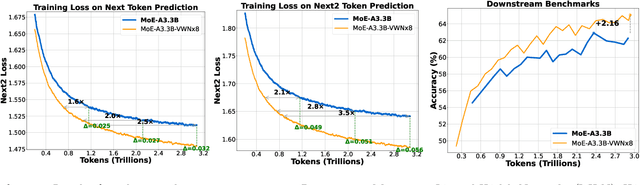
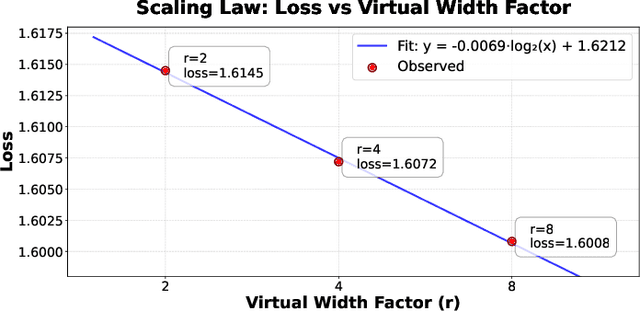
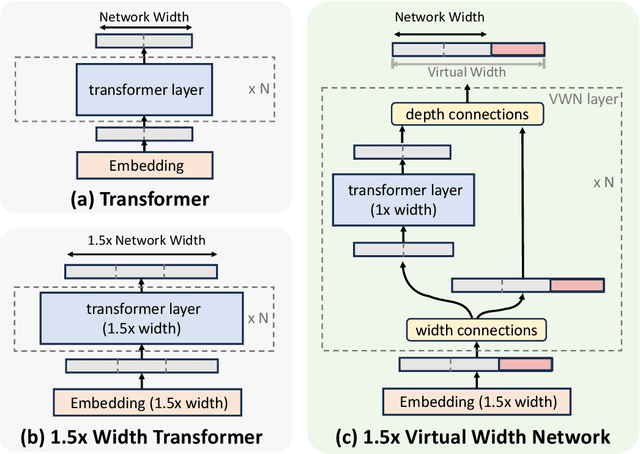
We introduce Virtual Width Networks (VWN), a framework that delivers the benefits of wider representations without incurring the quadratic cost of increasing the hidden size. VWN decouples representational width from backbone width, expanding the embedding space while keeping backbone compute nearly constant. In our large-scale experiment, an 8-times expansion accelerates optimization by over 2 times for next-token and 3 times for next-2-token prediction. The advantage amplifies over training as both the loss gap grows and the convergence-speedup ratio increases, showing that VWN is not only token-efficient but also increasingly effective with scale. Moreover, we identify an approximately log-linear scaling relation between virtual width and loss reduction, offering an initial empirical basis and motivation for exploring virtual-width scaling as a new dimension of large-model efficiency.
Truncated Proximal Policy Optimization
Jun 18, 2025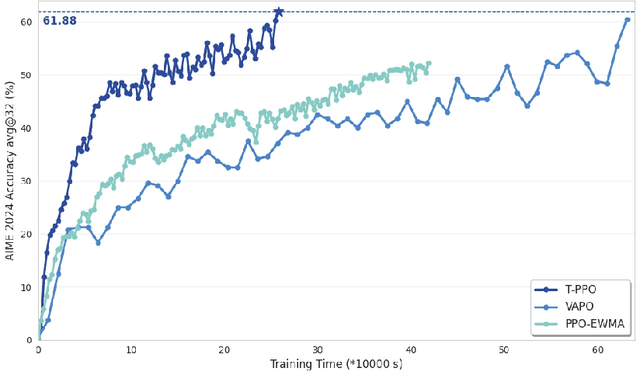
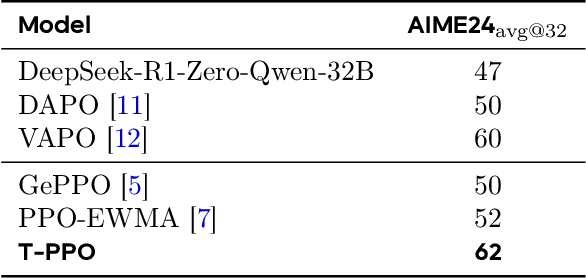
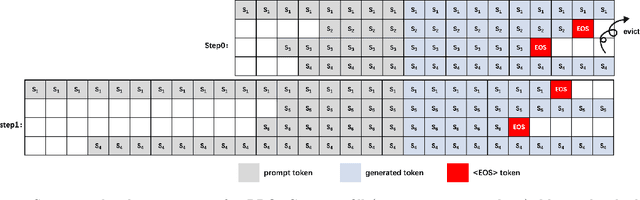
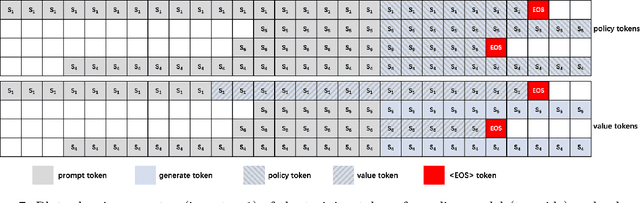
Recently, test-time scaling Large Language Models (LLMs) have demonstrated exceptional reasoning capabilities across scientific and professional tasks by generating long chains-of-thought (CoT). As a crucial component for developing these reasoning models, reinforcement learning (RL), exemplified by Proximal Policy Optimization (PPO) and its variants, allows models to learn through trial and error. However, PPO can be time-consuming due to its inherent on-policy nature, which is further exacerbated by increasing response lengths. In this work, we propose Truncated Proximal Policy Optimization (T-PPO), a novel extension to PPO that improves training efficiency by streamlining policy update and length-restricted response generation. T-PPO mitigates the issue of low hardware utilization, an inherent drawback of fully synchronized long-generation procedures, where resources often sit idle during the waiting periods for complete rollouts. Our contributions are two-folds. First, we propose Extended Generalized Advantage Estimation (EGAE) for advantage estimation derived from incomplete responses while maintaining the integrity of policy learning. Second, we devise a computationally optimized mechanism that allows for the independent optimization of the policy and value models. By selectively filtering prompt and truncated tokens, this mechanism reduces redundant computations and accelerates the training process without sacrificing convergence performance. We demonstrate the effectiveness and efficacy of T-PPO on AIME 2024 with a 32B base model. The experimental results show that T-PPO improves the training efficiency of reasoning LLMs by up to 2.5x and outperforms its existing competitors.
Model Merging in Pre-training of Large Language Models
May 17, 2025Model merging has emerged as a promising technique for enhancing large language models, though its application in large-scale pre-training remains relatively unexplored. In this paper, we present a comprehensive investigation of model merging techniques during the pre-training process. Through extensive experiments with both dense and Mixture-of-Experts (MoE) architectures ranging from millions to over 100 billion parameters, we demonstrate that merging checkpoints trained with constant learning rates not only achieves significant performance improvements but also enables accurate prediction of annealing behavior. These improvements lead to both more efficient model development and significantly lower training costs. Our detailed ablation studies on merging strategies and hyperparameters provide new insights into the underlying mechanisms while uncovering novel applications. Through comprehensive experimental analysis, we offer the open-source community practical pre-training guidelines for effective model merging.
VAPO: Efficient and Reliable Reinforcement Learning for Advanced Reasoning Tasks
Apr 08, 2025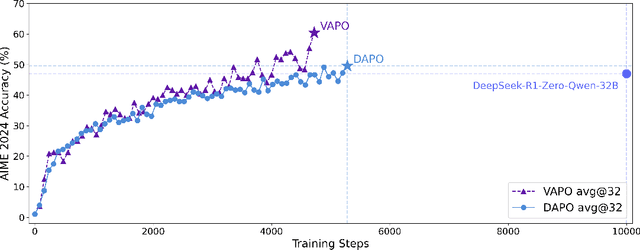
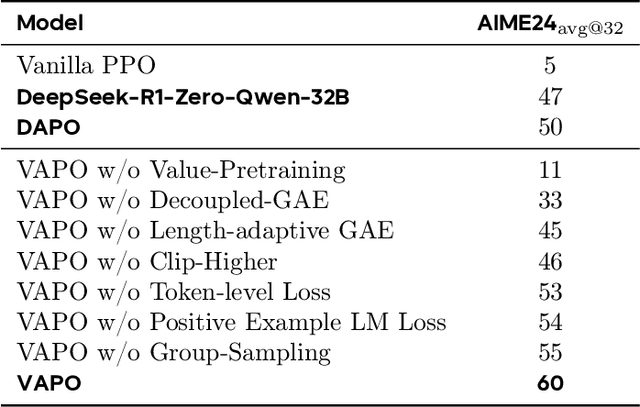
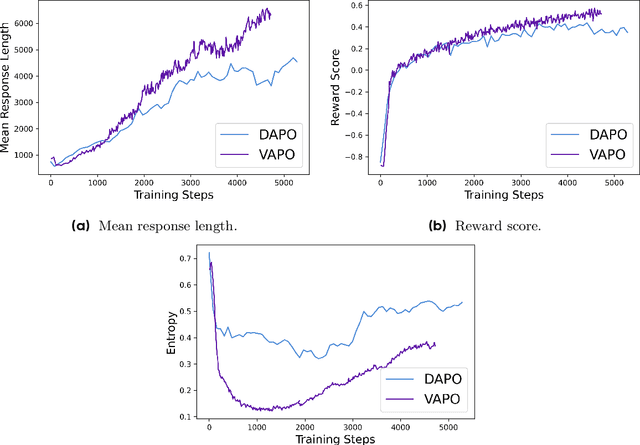
We present VAPO, Value-based Augmented Proximal Policy Optimization framework for reasoning models., a novel framework tailored for reasoning models within the value-based paradigm. Benchmarked the AIME 2024 dataset, VAPO, built on the Qwen 32B pre-trained model, attains a state-of-the-art score of $\mathbf{60.4}$. In direct comparison under identical experimental settings, VAPO outperforms the previously reported results of DeepSeek-R1-Zero-Qwen-32B and DAPO by more than 10 points. The training process of VAPO stands out for its stability and efficiency. It reaches state-of-the-art performance within a mere 5,000 steps. Moreover, across multiple independent runs, no training crashes occur, underscoring its reliability. This research delves into long chain-of-thought (long-CoT) reasoning using a value-based reinforcement learning framework. We pinpoint three key challenges that plague value-based methods: value model bias, the presence of heterogeneous sequence lengths, and the sparsity of reward signals. Through systematic design, VAPO offers an integrated solution that effectively alleviates these challenges, enabling enhanced performance in long-CoT reasoning tasks.